
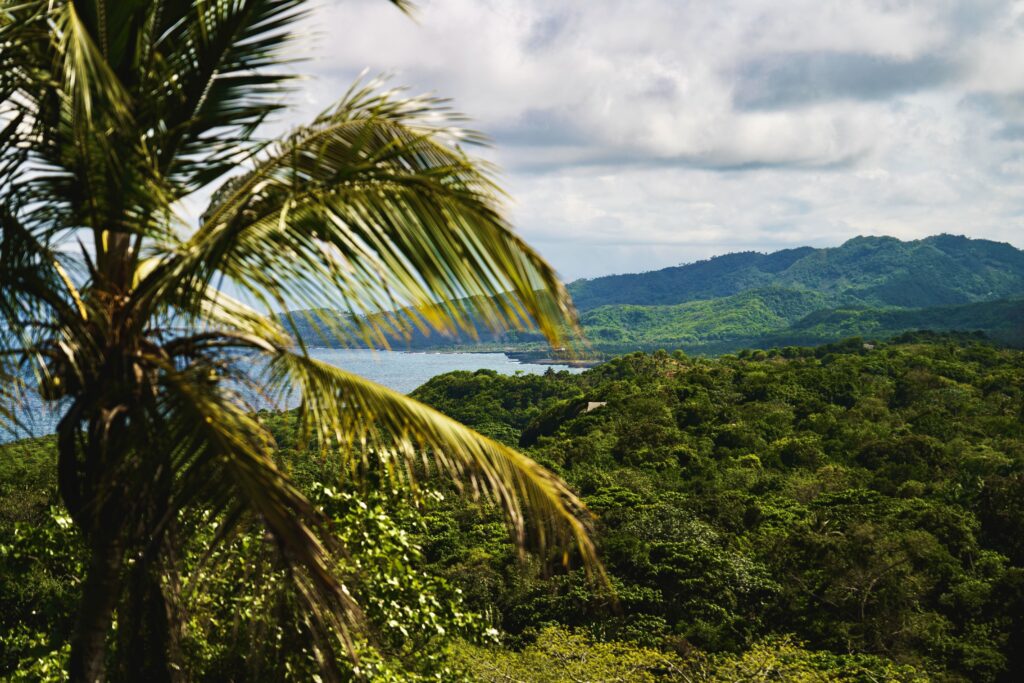
Planning a destination wedding surrounded by jungle, ocean views and, in season, humpback whales in Samaná Bay.
Picture telling your family where you’re getting married. It’s not a resort they’ve seen on a hundred vacation brochures. It’s a lush peninsula on the northeast coast of the Dominican Republic, where jungle-covered hills meet the sea, and humpback whales return to the bay each winter.
There might be a few seconds of silence, followed by: “Where is that?”
Welcome to Samaná.
For couples looking for somewhere that feels genuinely special, rather than a cookie-cutter resort, this corner of the Dominican Republic is a beautiful place to say “I do.”
Here’s what you need to know about planning a wedding here, including how your guests will get to Samaná, when to come, legal versus symbolic ceremonies, and what a wedding at Araya can actually look like.
Is Samaná better than Punta Cana for a wedding?
When people think about a destination wedding in the Dominican Republic, Punta Cana is often the first place that comes to mind. Understandably so. It’s well connected, familiar to international travelers, and home to plenty of large resorts that host weddings every week.
Samaná feels very different.
The peninsula is quieter, greener and a little wilder. Instead of one long stretch of resorts, there are fishing villages, palm-covered hills, waterfalls hidden in the forest, and beaches reached by boat or along small roads. Keep driving east, and eventually you reach Las Galeras, where the road quite literally runs out.
For a wedding, that changes the experience.
Your guests feel as though they’ve discovered somewhere. The journey becomes part of the trip, rather than simply the transfer from an airport to a resort.
You also don’t need to do quite so much to the setting. Jungle, ocean, and sky provide most of the backdrop for you. And because Samaná isn’t dominated by large resorts, a wedding here naturally feels more private.
Then there’s everything you can do before and after the wedding itself. Waterfalls, beaches, boat trips and (at the right time of year) whale watching, can turn a wedding into a memorable vacation for the entire group.
At Araya, we’re high above the coast, looking across the jungle canopy towards Samaná Bay. You get the feeling of being surrounded by tropical forest without giving up that huge ocean view.
You can discover more of the peninsula on our Adventure & Exploration page.
Getting your guests to Samaná
Getting here takes a little more planning than flying into one of the Dominican Republic’s larger resort areas, but it’s fairly straightforward once everyone knows their options.
Most international guests arrive through Santo Domingo or Punta Cana.
Santo Domingo Las Américas (SDQ)
For many guests, Santo Domingo is the simplest option. There’s a good choice of international flights from the US, Canada, and Latin America, and the drive to Araya takes around three hours.
The route from Santo Domingo heads north towards the Samaná Peninsula, and the scenery becomes increasingly tropical as you travel.
Punta Cana (PUJ)
Punta Cana often has very competitive international fares and a large choice of flights. The trade-off is the longer journey afterwards, which takes around five hours.
It can work particularly well for guests who want to spend a few days in Punta Cana before travelling north for the wedding.
Samaná El Catey (AZS)
El Catey is the closest airport to Araya, although it has far fewer international routes, and many are seasonal. It’s always worth checking flight schedules in case the available routes happen to work for your dates.
A few things we suggest telling guests before they book:
- Santo Domingo is usually the most convenient international gateway.
- An earlier arrival is helpful, so the transfer can be made during daylight, and guests can settle in before evening.
- Private and group transfers can be arranged in advance.
- Where possible, coordinating arrival days makes things much easier, particularly for a private resort wedding where everyone is staying together.
We’re happy to help coordinate the logistics, including arrival times and transfers, so you don’t have to leave every guest to figure it out individually.
When is the best time to get married in Samaná?
Samaná stays warm throughout the year, but the experience changes with the seasons.
Mid-January to March: Whale Season
These are popular months for good reason. The weather is generally drier, there’s often a welcome breeze, and humpback whales are in Samaná Bay.
For couples travelling with family and friends, whale season gives you something pretty extraordinary to add to the wedding trip.
April: The End of the Dry Season
April is warmer, generally still relatively dry, and quieter once the busiest part of whale season has passed. It can be a lovely time to visit if you want good weather without quite as many visitors around the peninsula.
May to November: Green Season
These months are warmer and more humid, and the landscape becomes incredibly lush. Tropical showers are more common, although they’re often short.
Atlantic hurricane season runs from June through November, with the highest activity typically occurring later in the summer and early autumn. If you’re considering these months, flexibility and good travel insurance are sensible.
December
By December, conditions are becoming drier again, while everything is still beautifully green. Visitor numbers begin to rise around Christmas and New Year, so holiday dates need a little more advance planning.
Getting married during whale season
There’s something particularly special about a wedding in Samaná between January and March.
Every winter, North Atlantic humpback whales migrate to the warm waters around Samaná to mate and give birth. During the season, boats head out from Samaná to see them in the bay.
It also makes for a memorable day-after-the-wedding plan.
Instead of everyone immediately packing their bags and heading home, you could spend the following morning on the water together, looking for whales. Seeing a mother and calf surface alongside the boat is the sort of experience people tend to talk about long after the wedding itself.
February is usually one of the busiest months for whale activity and visitors, so if you have your heart set on a wedding during the season, it’s worth planning well ahead.
We can also help arrange whale-watching trips and other excursions around the peninsula, including waterfalls and some of the area’s more secluded beaches.
A few practical things to know about the weather
Whatever month you choose, we generally plan ceremonies on Luna Terraza for later in the afternoon. The strongest heat has passed by then, and the light over the jungle and bay becomes much softer.
During green season, showers can arrive in the afternoon or evening. They often pass quickly, but we always think about the alternative plan, rather than simply hoping for sunshine. Both our yoga shala and Las Estrellas Restaurant provide covered spaces, so a tropical shower doesn’t have to bring the celebration to a stop.
For weddings between August and October in particular, we recommend that guests have appropriate travel insurance and keep an eye on forecasts as their travel dates approach.
It’s also worth thinking about your guests’ calendars. Winter weddings can be especially appealing to people travelling from colder climates, while summer dates may be easier for families working around school schedules.
Legal vs. symbolic weddings: Can US citizens get married in the Dominican Republic?
You can legally marry in the Dominican Republic, but there is paperwork involved.
A civil ceremony conducted by the appropriate Dominican authority can create a legally valid Dominican marriage. If you’re considering this option, check the current requirements both in the Dominican Republic and in your home country well before travelling. Documents may need to be prepared, apostilled, or translated into Spanish, depending on your circumstances.
For some couples, the easier option is to complete the legal marriage at home and have a symbolic ceremony in Samaná.
That doesn’t make the ceremony here feel any less like your wedding. You can still exchange vows and rings, have an officiant, and create the ceremony you want. In fact, a symbolic ceremony can give you more freedom over the wording, language, and person you choose to lead it.
Symbolic ceremonies at Araya are open to all couples, giving you the freedom to create a ceremony that reflects you and your relationship.
And whichever type of ceremony you choose, we can help you find an officiant who feels right for the occasion.
What does a wedding day at Araya look like?
There are two main spaces we use for weddings at Araya, and the celebration can move naturally between them as the afternoon turns into evening.
Luna Terraza
Luna Terraza sits above the jungle canopy, with Samaná Bay stretching into the distance.
The terrace can host ceremonies for up to 30 guests. We love it in the late afternoon, when the temperature begins to drop and the light across the water softens.
There’s very little competing with the view. You’re standing above the jungle, looking towards the Caribbean, surrounded only by the people you invited to be there.
Las Estrellas
After the ceremony, everyone can move to Las Estrellas Restaurant for dinner and the evening celebration.
Las Estrellas accommodates up to 40 guests, and can also be arranged for the ceremony itself if you’re planning a slightly larger wedding.
Dinner isn’t selected from a standard wedding package. The menu is created for your celebration and prepared by a chef engaged for the occasion.
Then the evening is yours, including dinner, speeches, music, conversations that go on much longer than expected, maybe some dancing.
One of the advantages of having the resort to yourselves is that there isn’t another wedding waiting for the space, or unrelated hotel guests wondering when the music will finish.
And the following morning, everyone is still here.
For us, that’s one of the nicest things about a private resort wedding. It doesn’t abruptly end when the reception finishes. You see everyone again at breakfast, around the pool, or heading out for the day, and the celebration slowly becomes a holiday together.
How far ahead should you start planning?
Many couples begin planning a destination wedding somewhere between six and 18 months before the date. There’s no single timetable you have to follow, but this gives you a useful starting point.
12 to 18 months before
Choose the time of year and secure your dates. Planning early is particularly useful for winter and whale-season weddings. Once the dates are confirmed, guests can start thinking about flights, vacation time, and budgets.
9 to 12 months before
Decide whether you want a legal or symbolic ceremony, and start sharing travel information with guests.
6 to 9 months before
Begin shaping the wedding weekend itself. That might include a welcome dinner, the ceremony and reception, a farewell breakfast and any group activities. This is also a good time to secure your photographer and other important suppliers.
3 to 6 months before
Menus, flowers, styling, music and the smaller details start coming together. Couples planning a legal ceremony should make sure the necessary documents are underway well before travelling.
1 to 3 months before
Confirm guest numbers, rooms, transfers and the final schedule.
The week of the wedding
Arrive. Settle in. Have a drink. Look at the view.
By this point, the important decisions should already have been made.
And if your timeline is much shorter than this, talk to us anyway. Not every wedding needs 18 months of planning.
The whole resort, just for you
For weddings, Araya can be booked as a complete private buyout.
A buyout gives your group exclusive use of our 11 villas, accommodating up to 26 overnight guests, along with Luna Terraza, Las Estrellas, the pool, and the spa.
There are no unrelated hotel guests sharing the pool, and no other event taking place alongside yours.
A full buyout has a three-night minimum, which works naturally for a destination wedding. One day to arrive and settle in, one for the wedding, and another to wake up slowly and enjoy being together before everyone starts heading home.
If you’re comparing private wedding venues, we’ve also put together a guide to an intimate wedding in the Caribbean, including what exclusive use actually means, and some of the questions worth asking before you book.
Your Samaná wedding starts here
Jungle below you. Samaná Bay in the distance. Whales out on the water (if you choose the right season). And, for a few days, the resort filled only with people you know.
Samaná isn’t the most obvious place to choose for a Caribbean destination wedding.
For many of our couples, that’s part of the appeal.
If you’re starting to think about dates, tell us what you have in mind. Our event planning team can help you work through the details and start shaping a few days in Samaná that feel like yours.